
Photography Inquiry Email Template – What to Send When a Lead Reaches Out
Responding to photography inquiries well is one of the most important things any photographer in business can learn how to do.
In my opinion, this is one of the most important moments of communication you have with any potential client. How you respond sets the tone for how you communicate with people. It also affects your ability to turn interest into an actual booking!
At the end of the day, if you are a photographer in business, your ability to make money with your service depends on your ability to get people to book you.
Of course, that does not mean one email magically books every client.
The process of getting someone to book with you is usually more than a single email. But your photography inquiry email template is often one of the most crucial turning points in that process. It is the moment where someone has raised their hand, shown interest, and given you an opportunity to guide them toward the next step.
This guide will walk through what makes a strong photography inquiry response, why I use both an automated and personal response, what to include in each email, and how to support those emails with follow-up, text messages, consult calls, and a stronger booking system.
The Short Version: What Should a Photography Inquiry Email Template Include?
Before I share a more detailed breakdown, I want to just break it down as simply as possible.
A photography inquiry email template should thank the lead for reaching out, acknowledge the details they shared, confirm availability when relevant, provide helpful next-step information, and give them a clear call to action.
A strong photography inquiry response (via email) often includes the following qualities:
- A warm greeting
- A thank you for reaching out
- A personal note based on their inquiry
- Availability confirmation, especially for weddings and events
- A helpful resource, pricing guide, gallery, or next-step link
- A clear call to action
- A professional sign-off
But in my own business, the inquiry response is not just one email!
I use two core inquiry response emails:
| When It Sends | Purpose | Should It Be Personalized? | |
| Automated inquiry response | Immediately after someone submits the contact form | Confirms the inquiry was received and keeps the lead engaged | Lightly, if possible |
| Personal inquiry response | After I review the inquiry | Responds to their specific details and guides them toward the next step | Yes |
From there, I also use follow-up emails, text messages, consult scheduling, proposal emails, and additional response variations depending on whether I am available, unavailable, or need more information.
That may sound like a lot, but the system is what makes the process easier to repeat…
Now, let’s start breaking all this down in more detail!
Your Inquiry Response Is Not Just One Email
Let me be clear here…If you are just starting out, you can absolutely simplify your process to one main photography inquiry response template.
That is better than having no template at all.
But over time, I think it is more effective to create multiple touchpoints around the inquiry process instead of relying on one email to do everything.
A new inquiry is not just a message in your inbox.
It is a potential client raising their hand!
They may be interested. They may be comparing you with other photographers. They may have questions. They may be busy. They may be overwhelmed. They may have reached out because something in your work, website, brand, or referral network gave them a reason to believe you could be the right fit.
Your job is to guide them from interest to the next step…
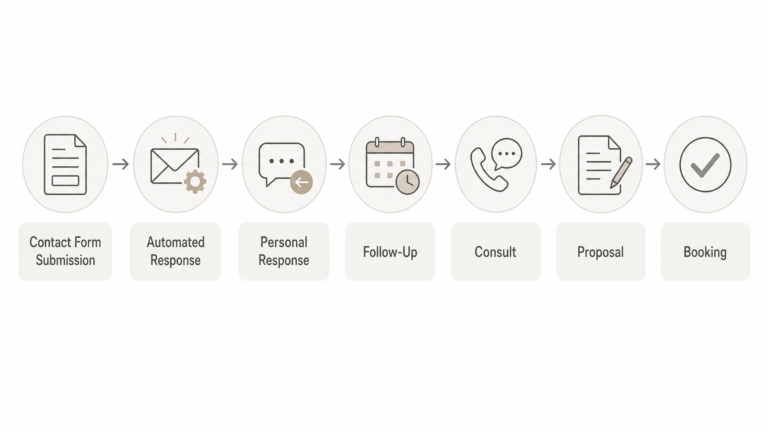
In my photography business, the first part of the inquiry process looks something like this:
- They submit the contact form.
- They receive an automated inquiry response.
- I review the inquiry.
- I send a personal inquiry response.
- They receive follow-up if they do not respond.
- They are guided toward a consult, proposal, or next step.
Your exact process may look a little different in practice if you want it to. But the underlying idea is the same.
The first response matters, but it is only one part of the larger inquiry-to-booking process.
Your Inquiry Email Starts With Your Contact Form
A strong photography inquiry email response actually starts before you write the email.
It starts with the contact form!
Well…why? You ask…good question!
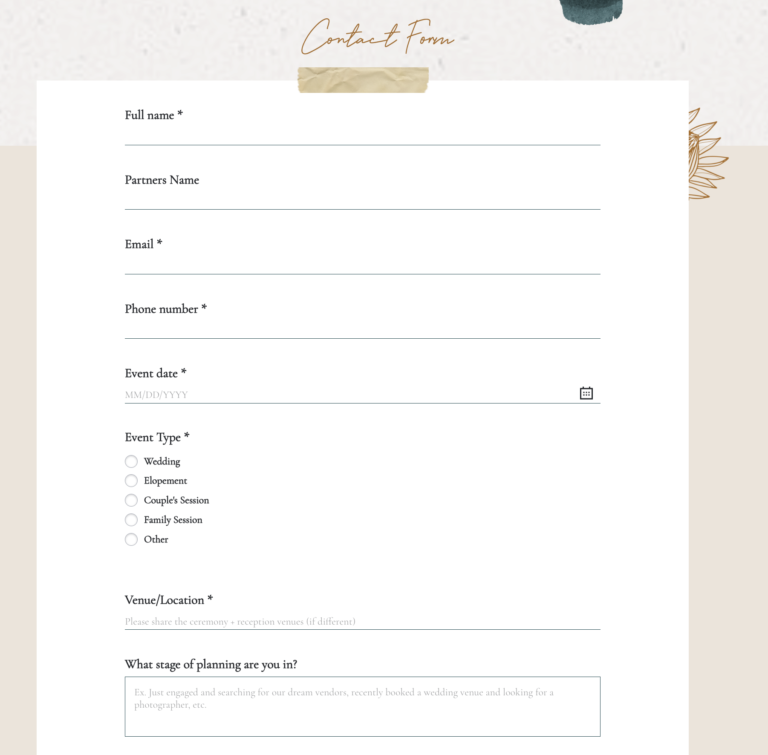
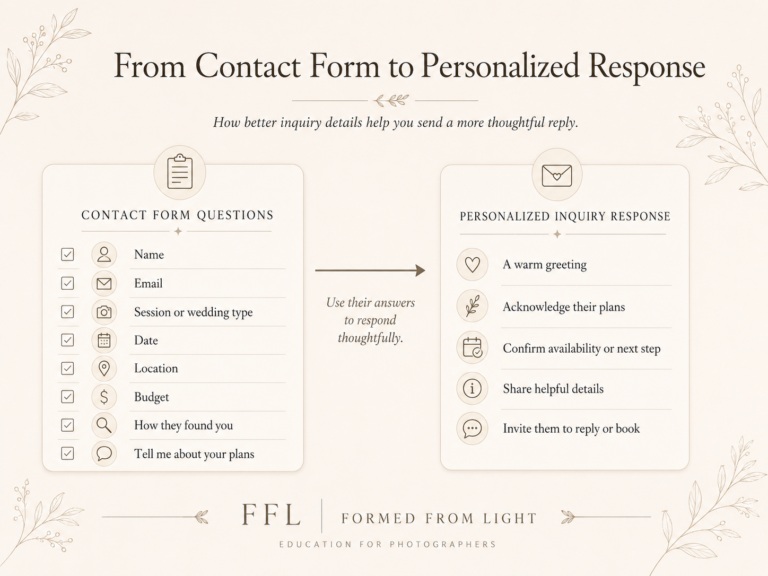
The more useful information someone shares when they inquire, the easier it is to respond in a way that feels specific, thoughtful, and relevant.
If your inquiry form only collects a name, email address, and a vague message box, you can still respond well. You just have less to work with.
That does not mean your contact form should feel overwhelming.
There is always a balance. You want to ask enough questions to understand the lead and respond well, but not so many that the form becomes annoying to complete.
For photographers, helpful inquiry form questions might include:
- What type of photography are you interested in?
- What date or timeframe are you considering?
- Where will the wedding, elopement, or session take place?
- What drew you to my work?
- What matters most to you when choosing a photographer?
- Is there anything specific you want me to know before I respond?
For wedding photography inquiry forms, you may also want to ask about the venue, guest count, desired coverage, planner involvement, and anything they already know about the timeline.
The point here is not to set up your form like it’s some way to interrogate someone.
The point is actually to give yourself enough context to respond like a real person.
To give you some examples – if they mention a venue I have photographed before, I can reference it. If they mention that they love candid or documentary-style images, I can connect that to how we approach a wedding day. If they are planning a smaller wedding or elopement, I may guide them toward a more fitting coverage option. If they are asking about a family session with young kids, I can reassure them that the session does not need to be perfectly controlled to go well.
Small details make a big difference because they show the person that you actually read what they sent.
The photography contact form questions are not just administrative. They are the raw material for a better inquiry response.
#1: The Automated Inquiry Response
The first photography inquiry email template I recommend creating is an automated inquiry response (you can click that link to sign up for a free inquiry response template!).
This is an email that gets triggered automatically when someone submits your contact form.
I use HoneyBook for this in my own photography business, but there are a variety of CRM platforms for photographers that can help you do the same thing.
The key point is that the response is automatic. It allows every person who inquires to receive at least one message from you quickly, even if you are at a wedding, with your family, asleep, editing, driving, or away from your computer.
That quick response matters. In fact, broad business statistics now show us that consumers expect a response from businesses within 5 minutes. 78% of customers hire the first person to respond, and you’re likelihood of booking someone drops by 80% if you respond after those first five minutes. Crazy, right!?!
Think about it like this…When someone reaches out, they are in a moment of interest. They are seriously thinking about hiring a photographer. They may even be actively comparing options. If your first response takes days, that interest can cool off or move toward someone else.
An automated email helps protect that first moment!
So here’s the thing, this automated response (in particular) doesn’t need to do everything. In fact, it probably should not try to do everything. The automated inquiry response is there to acknowledge the lead, reassure them that their message went through, and give them something useful to do until you can respond personally.
What to Include in an Automated Inquiry Response
Your automated inquiry response does not need to be long.
The goal is not to fully sell the client in this first email. The goal is to acknowledge the inquiry, set expectations, and give them something useful to do while they wait for your personal response.
A strong automated inquiry response can:
- Thank them for reaching out.
- Confirm that their message was received.
- Set expectations for when they will hear from you personally.
- Share a helpful next step.
- Give them a resource, gallery, guide, or link to explore.
- Keep the tone warm and professional.
In my own business, I have experimented with different things to include here.
I have shared full galleries so people can see complete examples of my work. I have shared planning resources. I have shared links to blog posts from previous events. I have used this email to help people learn something about my work, my process, or the thing they are currently planning.
There is no one perfect thing to send.
What you share depends on your business, your goals, the resources you have created, and what you want potential clients to see early in the process. A little experimentation here is always welcomed, but don’t overthink it (I know that can be easier said than done).
For example, if you are a wedding photographer, you might share:
- A full wedding gallery
- A wedding planning guide
- A venue guide
- A recent wedding blog post
- A pricing guide preview
- A consult scheduling link
- A “what happens next” page
If you do other genres of work like elopement photography, portrait photography, etc. – yo could see how you could adapt these ideas.
The most important thing to takeaway here is that whatever you share, it adds value.
It should help them learn something new, either about you and your work or about the wedding, elopement, session, or project they are planning!
Get a Free Automated Inquiry Response Email Template
Automated Inquiry Response Email Template for Photographers (Free Example)
Here is a simple automated inquiry response for photographers.
This is not meant to replace a more polished version, and you should adapt it to fit your own voice, services, and process. But it gives you a useful starting point.
Subject line: We got your inquiry!
Hi [Name],
Thank you so much for reaching out about [session type / wedding / event]. I’m so glad you found your way here.
I wanted to quickly let you know that your inquiry was received, and I’ll personally review everything you sent over. You can expect to hear back from me within [timeframe].
In the meantime, you can [view full galleries / read this planning guide / browse this resource / schedule a consult / learn more about the experience here]:
[LINK]
Thanks again for reaching out. I’m looking forward to learning more.
Talk soon,
[Name]
This kind of email works because it does a few simple things well…
- It confirms that the inquiry was received.
- It gives the lead a realistic expectation around when they will hear from you.
- It keeps them engaged with something useful.
- And it gives you a little breathing room to respond personally without leaving the lead sitting in silence.
For a photographer who is busy, shooting often, or managing work around family and life (all things I know too well), this is one of the simplest systems you can put in place.
If you want to get the Automated Inquiry Response Email I send to my own clients, download that here.
Why Sharing Full Galleries Can Work Well in Particular
One thing I often like to share early is full gallery examples (like might be included in the automated response above).
The reason is simple: many clients want to see more than portfolio highlights.
They want to know what a full wedding, elopement, or session actually looks like. They want to see consistency. They want to know what happens in imperfect lighting, real timelines, indoor spaces, outdoor spaces, reception lighting, family photos, candid moments, and everything in between.
For weddings and elopements especially, this matters a lot. A couple is usually not just evaluating whether your best portraits look good. They want to know whether you can handle the whole day: getting ready rooms, harsh midday sun, dim churches, family groupings, receptions, speeches, dance floors, and all the unpredictable pieces in between.
A full gallery gives them a better sense of what working with you could actually look like.
It also makes your personal response stronger because they have already had a chance to spend more time with your work!
#2: The Personal Inquiry Response
The second photography inquiry email template I send is the personal inquiry response.
This is probably the email most photographers are thinking of when they ask, “How do I respond to a new inquiry?”
Unlike the automated response, this email is more specific. You are reviewing what the person sent and responding with more direct guidance, that’s also (typically) more personalized.
For wedding and elopement inquiries, this often includes confirming whether you are available for their date. For portrait sessions, it may include responding to their session type, location, timeline, or specific questions.
This is where the lead should feel like an actual person read their inquiry and got back to them.
That does not mean you need to write every word from scratch. I am a big believer in using templates to simplify communication and make it quicker for you. But the template should leave room for real context: their date, their venue, their session type, their family, their goals, their concerns, or the specific question they asked.
That small bit of personalization helps your response feel more grounded.
Make Real Connection Before Pricing
People who reach out generally want to see more about pricing, packages, and what you offer as a whole. That is normal…
But they are usually also looking for more than numbers and dollar signs.
They are also looking for signs of emotional investment from you in them and what they are planning. That could be a wedding, elopement, family session, newborn session, branding session, or something else entirely. They want to know that you are not just replying to the next lead in the inbox. They want to feel, even briefly, that you understand what they are asking for and can help guide them.
That is why I like to create some sense of personal connection before sharing pricing (this can happen in the same email, btw).
This does not need to be overly sentimental or performative or long winded. A simple, specific sentence or two can be enough.
If they mention a venue I know, I might reference it. If they mention wanting candid, natural images, I might connect that to our approach. If they are planning a small elopement, I might acknowledge the intimacy of that kind of day. If they are asking about a family session with young kids, I might reassure them that the session does not need to be perfectly controlled to go well.
These small details make the response feel human.
Then, once that connection is made, the rest of the email can give them direction.
Share the Right Information in Your Response
There will be variation depending on your business model, but a strong personal inquiry response usually includes:
- A warm introduction
- A thank you for reaching out
- A personal note based on their message
- Availability confirmation, if relevant
- A response to any specific questions they asked
- A pricing guide, brochure, or next-step resource, if you share one
- A clear call to action
In my own photo business, I typically share my pricing brochure upfront. This gives them a more in-depth walkthrough of what I offer, how packages are structured, and what the next steps look like. I’ve found this to work well for me in how I like to approach sales and conversions have been consistent for a long time now, so I can’t complain with the process.
Keep in mind, though, not every photography business shares pricing up front. Some photographers prefer to discuss pricing on a consult call (as an example). Some want to qualify the lead first. Some work with custom quotes. These approaches can all be valid depending on what you sell and how your sales process is structured.
But regardless of whether you share pricing, the email needs a clear next step…
Guide Them Toward the Best Fit
In some cases, your inquiry response can do more than send information.
It can help the lead understand what option may actually make sense for them.
This is not a perfect fit for every business or sales process. Some photographers prefer to keep the initial email simple and talk through package recommendations on a consult call. Some services require custom quoting. Some leads may not give enough information to make a recommendation yet.
But when you do have enough context, guiding someone can be very effective…
For example, if a couple is planning a larger wedding day with multiple locations, a long timeline, and a full reception (and actually share this info in their initial message), I may gently point them toward a coverage option that gives enough room for the day to breathe. Likewise, if someone is planning a smaller elopement or more intimate wedding, I may guide them toward something that fits that scale better. If a family client mentions young kids, a tighter session window or a simpler location may make more sense than a complicated plan.
The point is not to pressure them into a package.
The point is to act like a guide.
Many clients do not know how many hours of wedding coverage they need. They may not know whether a second photographer is useful. They may not know what is realistic within a certain timeline. They may not know whether a package is too much, too little, or just right.
A simple line can help:
“Based on what you shared, I’d probably start by looking at [package/coverage option], but we can talk through what makes the most sense on a call.”
That kind of guidance can build trust because you are not just sending a pricing guide and leaving them to figure everything out alone. You are helping them interpret the information.
Give One Clear Call to Action at the End
How you close your email matters. Your inquiry response should not end vaguely.
The person should know what to do after they finish reading.
Your CTA might be:
- Schedule a consult call.
- Review the pricing guide.
- Reply with a few more details.
- Confirm the date.
- Choose a package.
- Fill out a follow-up form.
- Let you know if they would like a proposal.
My preference is usually to guide people toward a consult call or a clear booking pathway, depending on the service and where they are in the decision process.
But even a simple CTA is better than none.
Something like:
“If everything looks good, the next step would be to schedule a consult call here: [LINK].”
OR
“After you’ve had a chance to look through the pricing guide, just reply here and let me know if you have any questions or would like to set up a call.”
Simple. Clear. Directional.
That is what you want!
Personalized Photography Inquiry Response Template (Example Structure)
Here is a simple structure you can use for a personal photography inquiry response.
This is not meant to be a perfect copy-and-paste email for every business. It is a framework you can adapt based on your brand, service, and sales process.
Subject line: Thanks for reaching out about [wedding/session type]
Hi [Name],
Thank you so much for reaching out.
I had a chance to look through your inquiry, and I’m so glad you found your way here. [Add a personal sentence about their wedding, session, venue, family, location, or something they mentioned.]
I’m currently [available / potentially available / taking on sessions] for [date/session type], and I’d love to share a little more information with you.
You can find my pricing and package information here:
[LINK TO PRICING GUIDE / BROCHURE / RESOURCE]
Inside, you’ll find more about [briefly explain what is included: packages, process, galleries, next steps, etc.].
Based on what you shared, I’d suggest starting with [package / coverage option / next step], but we can talk through the best fit together.
The next step would be to [schedule a consult call / reply with any questions / let me know if you’d like a proposal / choose the option that feels like the best fit].
[CTA LINK OR INSTRUCTION]
Thanks again for reaching out. I’m looking forward to learning more.
[Sign-off]
The specific details should change based on your process, but the core architecture is solid:
- Thank them.
- Personalize.
- Confirm relevant information.
- Share helpful next-step content.
- Guide them where appropriate.
- Give them one clear action.
Personalized Wedding Photography Inquiry Email Template (Example Variation)
A wedding photography inquiry email template usually needs a little more structure than a basic portrait inquiry response.
The stakes are a bit higher. The date matters more (often it’s more locked in). The investment is usually larger. The client may be comparing multiple photographers. And because weddings are one-time events, couples need to feel confident that you are organized, experienced, and able to guide them.
For wedding inquiries, I would usually include information in the initial email response like:
- Their wedding date
- Whether you are available
- Their venue or location, if shared
- A personal note about their plans
- A link to pricing or next steps
- Full gallery examples, if useful
- A consult scheduling link
- A clear CTA
For example, if someone mentions a venue you have photographed before, that is worth acknowledging.
You might say something like:
“I saw you’re getting married at [Venue]. We’ve photographed there before, and it’s such a beautiful space, especially around [specific feature if applicable].”
This kind of personalization does not need to be dramatic. It just needs to show that you are paying attention.
Here is a simple wedding photographer inquiry response template you can adapt.
Subject line: Thanks for reaching out about your wedding
Hi [Name],
Thank you so much for reaching out and sharing more about your wedding.
I saw that you’re planning your wedding for [wedding date] at [venue/location], and it sounds like such a meaningful day. [Add one personal sentence about the venue, location, season, vision, or anything they mentioned in their inquiry.]
I’m currently available for [wedding date], and I’d love to share more information with you.
You can view my wedding photography pricing and package information here:
[LINK TO PRICING GUIDE / BROCHURE]
I’m also including a few full wedding galleries below so you can get a better sense of what a complete wedding day looks like from start to finish:
[LINK TO FULL GALLERY 1]
[LINK TO FULL GALLERY 2]Based on what you shared, I’d probably start by looking at [package / coverage option], but we can talk through what makes the most sense for your day.
If everything feels like it could be a good fit, the next step would be to schedule a consult call here:
[CONSULT SCHEDULING LINK]
That gives us a chance to talk through your plans, answer questions, and make sure the coverage options fit what you’re looking for.
Thanks again for reaching out. I’m looking forward to learning more about what you’re planning.
[Sign-off]
The goal is to acknowledge their plans, confirm whether you are available, give them useful information, and guide them toward a next step. For wedding, elopement and portrait clients alike , that next step is often a consult call because it lets them get a better feel for you beyond the pricing guide.
Create Variations for Different Inquiry Situations
One thing that has helped my process over the years is building variations of my photography inquiry email templates.
I photograph weddings, elopements, and different types of portrait sessions, so I do not send the exact same response to every type of inquiry.
The general architecture may be similar, but the details change.
A family session inquiry does not need the exact same response as a wedding inquiry. A maternity session does not need the same email as an elopement inquiry. A client asking about a full wedding day does not need the same next step as someone asking about a short portrait session.
At minimum, consider creating variations for the types of photography services you offer. These might include variations like I have:
- Wedding inquiries
- Elopement inquiries
- Family session inquiries
- Engagement session inquiries
- Maternity or newborn inquiries
- Branding or headshot inquiries
- Unavailable wedding dates
- Budget mismatch inquiries
- Inquiries that need more information
These variations let you respond faster without sounding generic.
They also help you avoid the mismatch that can happen when someone asks about one thing and receives a response that clearly feels built for another.
The structure can be templated, but the response should still fit the inquiry.
What to Send If You Are Unavailable
If you are a wedding or elopement photographer (especially), you will eventually receive inquiries for dates you are already booked.
Most photographers respond with something like:
“Sorry, I’m unavailable.”
That works, but it may not be the best first move.
In my own business, I have a small sequence around this. If someone inquires for a wedding date I already have booked, I often ask them to confirm that the date is correct before fully closing the door.
There are two reasons for this.
First, people sometimes mistype their date when submitting a contact form.
Second, on a few occasions, people have been so interested in working with us that they changed their date after finding out we were unavailable.
I would not build your entire process around that. It is definitely an outlier.
But it can happen!
And by simply checking in, you may save an opportunity you otherwise would have assumed was gone.
If they confirm that the date is correct and you are truly unavailable, then you can send a thoughtful referral response.
A good unavailable response should:
- Thank them for reaching out.
- Let them know you are unavailable.
- Offer referrals if appropriate.
- Keep the tone warm.
- Invite them to reach out again for future photography needs.
This creates a better experience even when you cannot take the work.
A person you refer out today may remember you later. They may reach out for portraits. They may recommend you to someone else. They may appreciate that you handled their inquiry with care instead of giving them a cold one-line rejection.
In Practice: How This Works in My Business
So, I’ve spent a lot of time sharing a lot of ins-and-outs of photography inquiries and responding via email, but now I want to break down what this can look like in practice…
Someone submits a wedding inquiry while I am away from my desk. Maybe I am photographing a wedding, driving to a session, spending time with my family, or just not in a position to respond thoughtfully in that exact moment. Certainly not within the next 5 minutes like I mentioned earlier…
The automated inquiry email response goes out right away…
That email lets them know their inquiry was received, gives them an expectation for when they will hear back personally, and points them toward something useful, such as full galleries, a planning resource, or another next step.
Later, when I can actually sit down and review the inquiry, I look at the details more carefully. Ideally, I try to get to this ASAP but at most within a day.
I am checking the date, venue, location, type of service, what they shared about their plans, whether I am available, and whether it seems like a strong fit for the kind of work we do.
Then I send a personal response.
That response might confirm availability, mention something specific from their inquiry, share my pricing brochure, link to full galleries, and invite them to schedule a consult call. If they do not reply, the follow-up sequence continues. Depending on the situation, I may also send a short text to make sure the email made it to them and to add another touchpoint.
That is the real value of having a system.
It does not mean the process becomes impersonal. It means the important pieces happen consistently, even when life and business are busy (which things often are!).
Of course, these are just the initial inquiry responses, for people who don’t get back to me after these…there’s more to come…
Do Not Stop After the First Inquiry Response
As we’ve highlighted through this post, your automated response and personal inquiry responses are clearly important. But they are still just the beginning…
After those emails are sent, you now need to make sure you have a good follow-up process in place.
I cover follow-up sequences in more depth in other articles, but at a high level, the point is simple: do not abandon a lead just because they did not respond to your first message.
I have had many people over the years not respond to my first email. Sometimes they do not respond after one follow-up or two follow-ups or three. Sometimes people get back to me after a month’s worth of follow-up emails have gone out…
Some of those people have gone on to book.
That matters a ton!
As a business, I have worked very hard to get those leads to come in the door. I do not want to abandon them just because they did not respond immediately.
For some photographers, following up can feel pushy or salesy. I would challenge that perspective.
If someone submitted your contact form, they expressed interest. Following up is not pestering when it is done with care. It is a way to stay helpful, stay visible, and give them more opportunities to continue the conversation.
A good photographer inquiry follow-up email can:
- Stay top of mind
- Share helpful resources
- Answer common questions
- Show full galleries
- Explain what makes your process different
- Invite them to schedule a call
- Give them a final soft close
The key is that follow-up emails should add value.
They should not all just say, “Just checking in.”
If you’re wanting help creating a better process that takes new leads to bookings, check out our Inquiry to Booking System for Photographers. This is a system made up of email templates, text message templates, as well as walkthroughs and other guidance to help you implement it into your photography business.
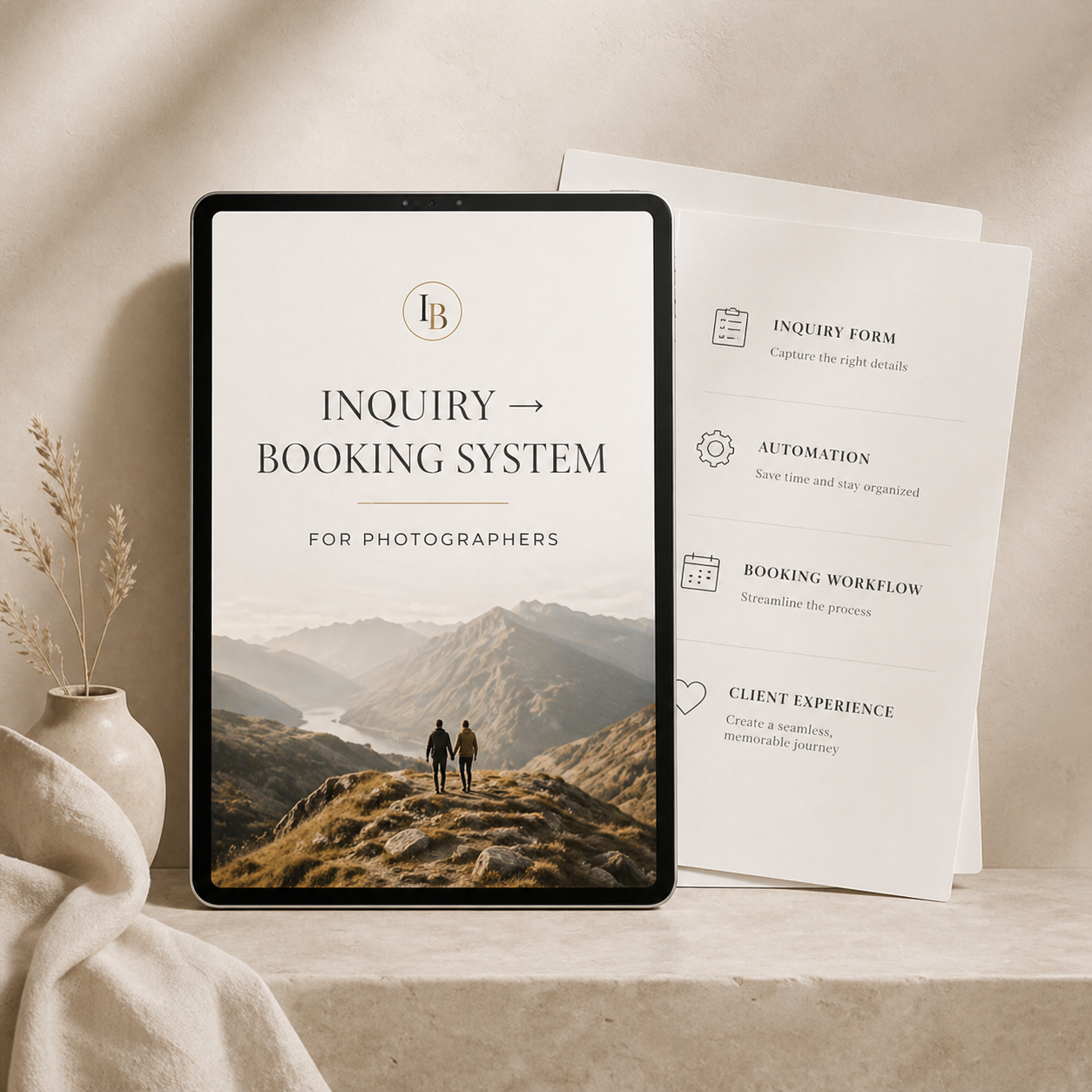
Explore the Inquiry to Booking System for Photographers
Pay Attention to What Actually Gets Replies
As a photographer in business for over 10 years, let me tell you – a photography inquiry email template should not be frozen forever.
You want to pay attention to what actually gets replies, consult calls, proposals, and bookings.
This does not need to be overly complicated. You do not need a giant spreadsheet or advanced sales dashboard to start noticing patterns. But over time, you should have some sense of where leads are dropping off.
For example, if people respond to your automated email but go quiet after you send pricing, it may be worth looking at how your pricing guide is framed or whether your next step is clear enough. If people open your emails but don’t schedule consult calls, you might test a different CTA. If leads consistently ask the same question after receiving your response, that may be a sign that the email or pricing guide needs to answer that question earlier.
The goal is not to obsess over every lead.
Some people will not book, no matter how good your email is. That is normal.
But if you are seeing the same pattern again and again, pay attention. Your inquiry emails should evolve based on real client behavior, not just what sounds good in theory.
Support Inquiry Emails With Texts, Calls, and Scheduling Links
Email is important, but it should not be the only way you communicate with new leads.
People miss emails. Emails land in junk folders. People skim and forget. Someone may be interested but never see your response because their inbox is full of wedding vendor messages, personal communications, and messages from other companies they’re subscribed too…
This is why I like supporting inquiry response emails with other forms of communication.
For me, text messages are the most common support channel since it’s easy enough to implement.
A text does not need to be complicated. It may simply let them know that you sent more information by email and want to make sure it reached them.
Something like:
“Hey [Name], this is [My Name] from [My Photo Company]. I just sent over more info about your photography inquiry. Wanted to make sure it made it to you.”
This gives them another way to see your response and another way to get back to you.
Consult calls can also be valuable, especially for weddings, elopements, or higher-value services. A call gives the client a chance to connect with you more directly, ask questions, and get a better sense of whether you are the right fit.
The strongest inquiry systems usually use more than one communication method. I generally treat email as the foundation. But…text messages, calls, and so on can support it.
Photographer Inquiry Email Subject Lines
Subject lines do not need to be clever, but they should be clear.
A good subject line helps the lead understand what the email is about and makes it easier to find later. This is especially useful when someone is planning a wedding and receiving emails from photographers, venues, planners, florists, DJs, and other vendors at the same time.
Here are a few photographer inquiry email subject lines you can adapt:
- Thanks for reaching out about your wedding
- We got your inquiry!
- Your photography inquiry: next steps
- More info about your wedding photography inquiry
- I’d love to hear more about your session
- A few next steps for your photography inquiry
- Your wedding photography info is here
- Thanks for your inquiry about [session type]
- Let’s talk through your photography plans
- A quick note about your wedding inquiry
For an automated response, I usually like something simple and confirming.
For a personal response, I like something that ties directly to the service or inquiry. If someone is asking about a wedding, say wedding. If someone is asking about a family session, say family session. Clarity is usually better than trying to be overly clever.
9 Common Mistakes Photographers Make With Inquiry Emails
A good photography inquiry response does not need to be complicated, but there are a few mistakes worth avoiding.
1). Taking Too Long to Respond
Speed matters. This is one of the biggest reasons I recommend setting up an automated inquiry response. Even if you cannot personally respond right away, the lead still hears from you quickly.
2). Making the Email Too Generic
Templates are useful, but the personal response should still feel like you read their message.
A small personal note can go a long way…
This could be as simple as mentioning their venue, session type, location, timeline, or something they shared in the form. The point is not to overdo it. The point is to avoid making the email feel like it could have been sent to anyone.
3). Giving Too Much Information at Once
Your inquiry response should be helpful, not overwhelming.
If you have a lot to share, consider using a pricing guide, brochure, resource page, or consult call instead of stuffing everything into one massive email.
A good inquiry response guides the lead. It does not bury them.
4). Forgetting the CTA
If the lead does not know what to do next, your email is weaker than it should be. Give them direction.
The next step can be as simple as scheduling a consult, reviewing a pricing guide, replying with questions, or confirming whether they would like a proposal.
5). Using Vague Pricing Language
If you share pricing, make it clear where the person can find it and what they are looking at.
If you do not share pricing yet, make the next step clear. For example, you might invite them to schedule a call where you can talk through coverage options and recommend the best fit.
What you want to avoid is vague language that leaves the person wondering whether you are intentionally hiding information or whether they missed something.
6). Including Too Many Links
Links can be helpful, but too many links can create decision fatigue.
If you send a pricing guide, five galleries, three blog posts, a scheduling link, a testimonial page, and your Instagram profile all at once, the lead may not know what matters most.
Prioritize the links that support the next step!
7). Sounding Apologetic or Desperate
There is a difference between being warm and sounding uncertain.
Avoid over-apologizing, over-explaining, or making the email feel like you are trying too hard to convince someone to like you.
A calm, clear response usually builds more trust than a message that feels desperate.
8). Not Following Up
Many photographers lose opportunities because they send one email and stop. In my view, receiving that inquiry form submission is just part of the process, but now we often need to continue marketing to that person to get them to schedule a call and book with us.
Some leads need more time, more touchpoints, or more reminders before they are ready to move forward…
9). Only Using Email
As we’ve made clear through this article, email is important, but it is not always enough. A simple supporting text message can make it much more likely that the lead sees your response. Did you know that texting has a 98% open rate?
Photography Inquiry Email Templates You Can Use
If you want to build this yourself, start simple.
Create one automated inquiry response and one personal inquiry response.
Then, over time, build variations for different service types, unavailable dates, follow-up emails, consult scheduling, proposal delivery, and booking confirmation.
This is one part of a larger communication system inside your photography business. Once someone books, your emails shift from inquiry-to-booking communication into client experience communication: welcome emails, planning emails, questionnaires, session preparation, gallery delivery, review requests, and longer-term follow-up.
You do not need to build all of that at once.
But it is worth understanding that the inquiry response is only the beginning. It is one of many pieces of communication you will want to do well.
If you want a faster starting point, I have a few resources built specifically for photographers.
Free Automated Inquiry Response Email
I offer a free automated inquiry response email template for photographers.
This is meant to help you improve the first message someone receives after they submit your contact form. It gives you a stronger starting point for responding quickly, setting expectations, and keeping new leads engaged.
Get a Free Automated Inquiry Response Email Template
Inquiry to Booking System for Photographers
The Inquiry to Booking System for Photographers is the paid system I built around the full process of moving someone from inquiry to booked client.
It includes email templates, text message templates, follow-up sequences, implementation guidance, and walkthroughs to help you set up a more structured inquiry-to-booking process inside your own business.
This is the product most directly connected to this article.
If your inquiry responses feel scattered, inconsistent, too slow, or too dependent on writing everything from scratch, this is the system I would point you toward.
Explore the Inquiry to Booking System for Photographers
Client Experience Nurturing System for Photographers
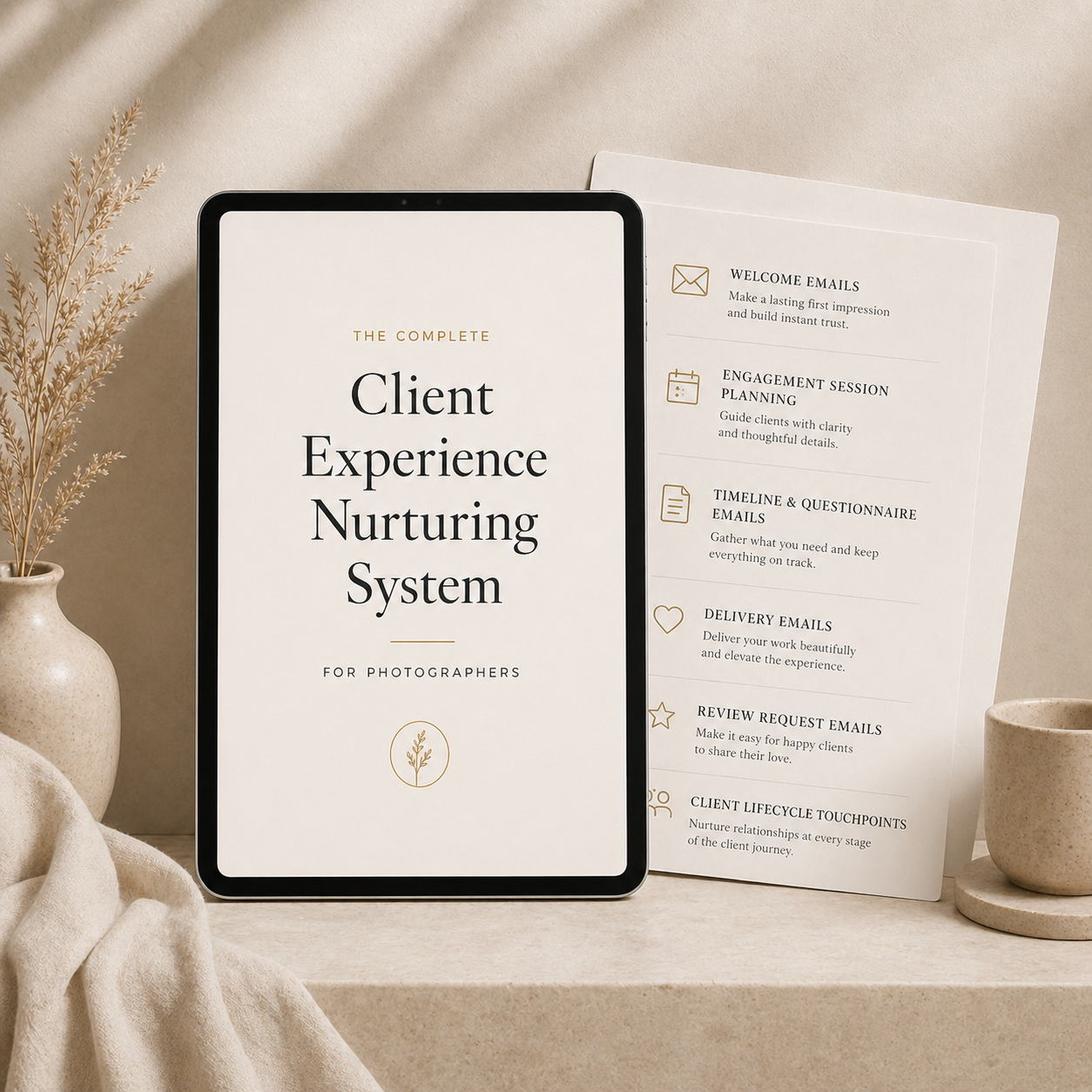
The Client Experience Nurturing System is another product I created that is focused on what happens after someone books…
It includes emails and touchpoints for welcome messages, planning, session preparation, wedding communication, gallery delivery, review requests, and post-client follow-up…along with extensive walkthroughs and supporting materials to make it easy to implement into your photo business.
Explore the Client Experience Nurturing System for Photographers
Together, these systems form the backbone of a stronger client communication process.
FAQ: Photography Inquiry Email Template
What should a photography inquiry email template include?
A photography inquiry email template should include a thank you, a personal acknowledgment of the inquiry, availability confirmation if relevant, helpful next-step information, and a clear call to action.
For weddings, it should usually also address the date, venue or location, pricing or next steps, and how to schedule a consult.
Should photographers use an automated inquiry response?
Yes, I recommend using an automated inquiry response so every new lead hears from you quickly after submitting your contact form.
This does not replace your personal response. It simply creates an immediate first touchpoint while you prepare a more specific reply.
What is the difference between an automated and personal inquiry response?
An automated inquiry response is sent immediately after someone submits your form. It confirms the inquiry was received, sets expectations, and gives the lead something helpful to do.
A personal inquiry response is sent after you review the inquiry. It includes more specific information, personalization, availability confirmation, pricing or next steps, and a clearer CTA.
Should I send pricing in my photography inquiry response?
This depends on your business model.
Some photographers share pricing up front through a pricing guide or brochure. Others prefer to discuss pricing on a consult call. Both approaches can work, but your email should still guide the lead clearly toward the next step.
How fast should photographers respond to inquiries?
Ideally, new leads should receive some kind of response very quickly. This is why an automated inquiry response is useful.
For the personal response, I try to reply as soon as reasonably possible, often within 24 hours during business hours.
Should photographers follow up after sending an inquiry response?
Yes. Follow-up is one of the most important parts of the inquiry-to-booking process.
Some leads will not respond to the first email, even if they are interested. A thoughtful follow-up sequence helps you stay visible, provide more value, and give them another chance to continue the conversation.
What subject line should I use for a photography inquiry response?
A good subject line should be clear and directly connected to the inquiry.
For example:
Thanks for reaching out about your wedding
Your photography inquiry: next steps
More info about your family session
We got your inquiry!
A few next steps for your photography inquiry
For automated responses, keep the subject line simple and confirming.
For personal responses, make it more specific to the service they asked about.
What questions should photographers ask on their inquiry form?
Photographers should ask enough questions to understand the lead and respond personally without making the form feel overwhelming.
Useful questions may include the service type, date, location, venue, what drew them to your work, what matters most in choosing a photographer, and any specific questions or concerns they want you to know about.
For wedding photographers, inquiry form questions about the venue, desired coverage, guest count, and planning priorities can make the personal response much easier to write.
Should I recommend a photography package in my inquiry response?
Sometimes, yes.
If the lead gives you enough information, recommending a package or coverage option can help position you as a guide instead of just sending pricing and leaving them to figure it out alone.
This does not need to be pushy. You can say something like, “Based on what you shared, I’d probably start by looking at [package/coverage option], but we can talk through what makes the most sense together.”
Can I use the same inquiry email template for every type of photography?
You can use the same basic structure, but I recommend creating variations for different service types.
Wedding inquiries, elopement inquiries, family sessions, branding sessions, and unavailable-date responses all have different needs. The architecture can stay similar, but the details should change.
Final Thoughts
A strong photography inquiry email template is not just about sounding professional.
It is about helping a potential client feel guided!
Your response should show that you received their message, understand what they are asking for, have a clear process, and can help them take the next step.
In the beginning, one template is better than nothing.
But over time, I would think beyond a single email. Build a simple system around your inquiry process: automated response, personal response, follow-up sequence, text support, consult scheduling, proposal delivery, and booking confirmation.
That is where the real strength comes from.
The goal is not to make your communication complicated.
The goal is to make it consistent, thoughtful, and easier to repeat.
Your inquiry response emails also fit into a larger system of emails and communication within your business. This is just one of many things you will want to do well. But it is an important one because it sits at the point where interest can either become momentum or quietly fade away.
If your inquiry process feels scattered right now, start with the first two emails: automated inquiry response and personal inquiry response. Those alone can make a meaningful difference!
Where to Go Next
If you want a simple starting point, download the free automated inquiry response email and use it to improve the first message people receive after they inquire.
If you want the full inquiry-to-booking process, including email templates, follow-up sequences, and implementation guidance, explore the Inquiry to Booking System for Photographers.