How Do Photographers Get Clients? A Practical Guide to Getting Booked!
How do photographers get clients?
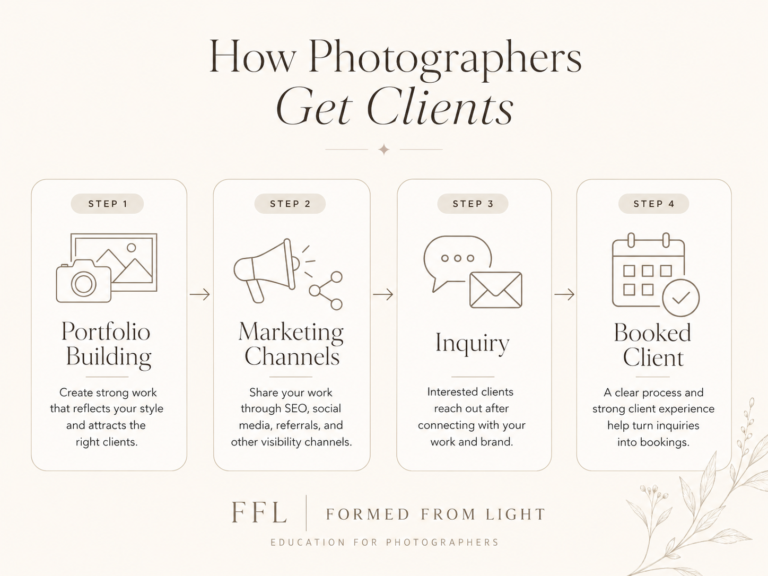
At a basic level, photographers get clients by building a portfolio people trust, creating an offer that is clear enough to understand, marketing their work through the right channels, and having a process that takes someone from interested to officially booked.
That might sound straightforward enough, but if you are at the beginning, it can feel anything but simple!
You can love photography. You can have a decent camera. You can take good photos. And still, when it comes time to actually get someone to hire you, the whole thing can feel unclear.
Questions will run through your mind like…Where do clients come from? How do you get your first few bookings? Should you focus on Instagram, SEO, referrals, wedding venues, email marketing, paid ads, local groups, or something else entirely? And once someone reaches out, how do you make sure the opportunity does not disappear?
I have been a professional photographer for more than 10 years now. My wife and I work together as wedding, elopement, and portrait photographers, and these days our business has a strong system in place for generating leads and booking clients consistently.
But it was not always that way…
We started from scratch. Our first clients came from friends, family, social media feelers, low-priced early offers, and even a random Craigslist listings at the time. Over time, we built a portfolio, refined our brand, raised our prices, improved our website, created better packages, built referral relationships, and developed systems that made it easier for people to inquire and book.
This guide will walk through how photographers get clients in a practical way, whether you are trying to book your first paid shoot or you already have a business and want more consistent leads.
The Short Answer: How Do Photographers Get Clients?
Photographers get clients by making their work visible, building trust with the right audience, creating a clear offer, and guiding interested people through a simple booking process.
The main ways photographers get clients include:
- Friends, family, and personal networks
- Portfolio-building shoots
- Word of mouth referrals
- Social media
- SEO and blogging
- Google Business Profile
- Vendor and venue relationships
- Directory listings
- Email marketing
- Past client marketing
- Cold outreach
- Paid advertising
- A strong website and inquiry process
The important thing to understand is that getting clients is not just one thing…
It is not only posting on Instagram.
It is not only having a nice portfolio.
It is not only asking for referrals.
Instead, it is the full path someone moves through (called a “marketing funnel” – we’ll cover this more in a bit!):
- They become aware you exist.
- They see enough of your work to become interested.
- They trust you enough to reach out.
- You respond in a way that keeps the conversation moving.
- You make it easy for them to officially book.
That full path matters a whole lot!
A lot of photographers only focus on the first step: getting attention. That’s especially true when they are initially thinking about “how do I get clients.” But attention does not automatically become bookings and money. You also need trust, clarity, communication, and a booking process that is repeatable from person to person.
Start by Understanding the Client Path
Before talking about specific photography marketing channels, it helps to reverse engineer what happens when someone hires a photographer.
Usually, the process looks something like this:
- They need photography for something specific (portraits, weddings/events, etc.).
- They become aware of you through search, social media, referrals, vendors, directories, or someone they know.
- They look at your portfolio.
- They read your website, reviews, pricing information, blog posts, or social content.
- They decide whether you feel trustworthy enough to contact.
- They submit an inquiry.
- You respond and guide them to the next step.
- They schedule a call, review your pricing, or ask questions.
- They sign a contract and pay a retainer.
That is the client path in a nutshell.
When photographers struggle to get clients, the problem can happen anywhere along that path…
Maybe people do not know you exist. Maybe they find you, but your portfolio is not strong enough. Maybe your website is confusing. Maybe your pricing or packages are unclear. Maybe people inquire, but you take too long to respond. Maybe you have interested leads, but no good system for moving them toward booking.
This is why getting clients is not only a marketing problem. It is also a brand problem, a trust problem, an offer problem, and a systems problem. I know it can feel a little overwhelming, anxiety inducing and even scary at times…but…
That is actually good news!
It means you do not have to assume, “I’m just bad at marketing,” or “people don’t want to hire me.” Sometimes the issue is much more specific than that. You may just need better portfolio proof, clearer pricing, stronger CTAs, faster follow-up, or a smoother photography booking process.
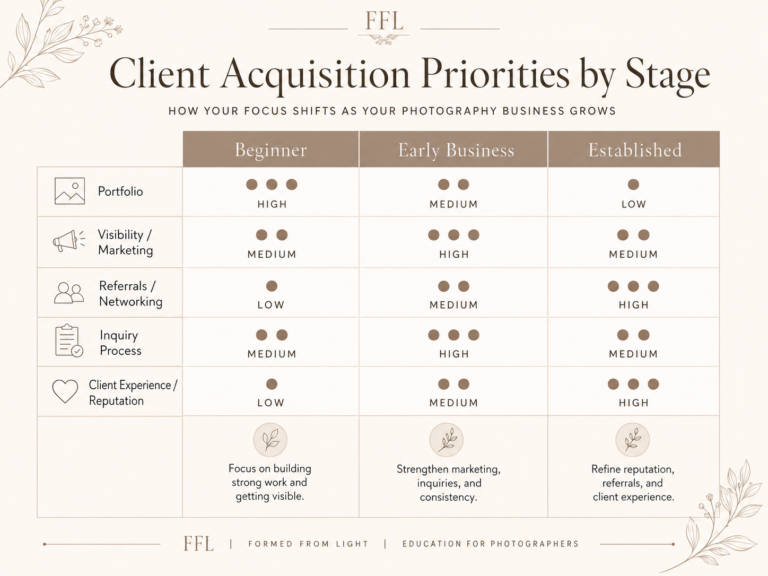
The Best Way to Get Clients Depends on Your Stage
The best way to get photography clients depends on where you are in the business.
A beginner photographer should not have the exact same priorities as someone who is already booking regularly.
A photographer trying to get their first few paid shoots needs proof, confidence, and visibility.
A working photographer with consistent inquiries may need better conversion, stronger systems, and more intentional lead sources.
This is where a lot of advice online gets messy. Someone might say, “You need SEO,” and that can be true. Someone else might say, “You need to post more on Instagram,” and that can also be true. Someone else might tell you to network with venues, run ads, start an email list, or launch a referral program.
All of those can work. In fact, I’ve done them all and they all fit part of a larger marketing and sales process.
But not all of them are the right first step for every photographer…So let’s break down what tends to work based on where you’re starting from:
If You Are a Beginner Photographer
If you are brand new, focus on things like:
- Building a small portfolio
- Creating one clear offer
- Using your personal network to get some early shoots
- Posting model calls or portfolio-building opportunities
- Getting your first reviews
- Learning how to communicate with real clients
- Making it easy for people to inquire with you
At this stage, you are building evidence. You need proof that you can do the work, communicate clearly, and deliver what you promised.
If You Have an Early Photography Business
If you have some experience but leads are inconsistent, focus on:
- Improving your website
- Clarifying your packages
- Getting more reviews and trust signals
- Creating a stronger inquiry response process
- Asking for referrals
- Publishing useful content
- Building relationships with vendors or local businesses
- Starting to do some online marketing (like posting on Instagram)
This is often where the business starts to feel more real.
You are no longer just trying to get any booking. You are trying to create a repeatable way for the right people to find you, trust you, and hire you.
If You Are Already Getting Inquiries
If people are already reaching out but not booking consistently, focus on:
- Improving your response speed
- Strengthening your pricing guide or proposal
- Following up more intentionally
- Tracking where leads come from
- Reviewing your booking rate by source
- Using a CRM to stay organized
- Looking at where leads drop off
At this stage, more visibility may help, but it may not be the main issue. Sometimes the better move is to improve how well you convert the attention you already have.
Build a Portfolio That Gives People Confidence
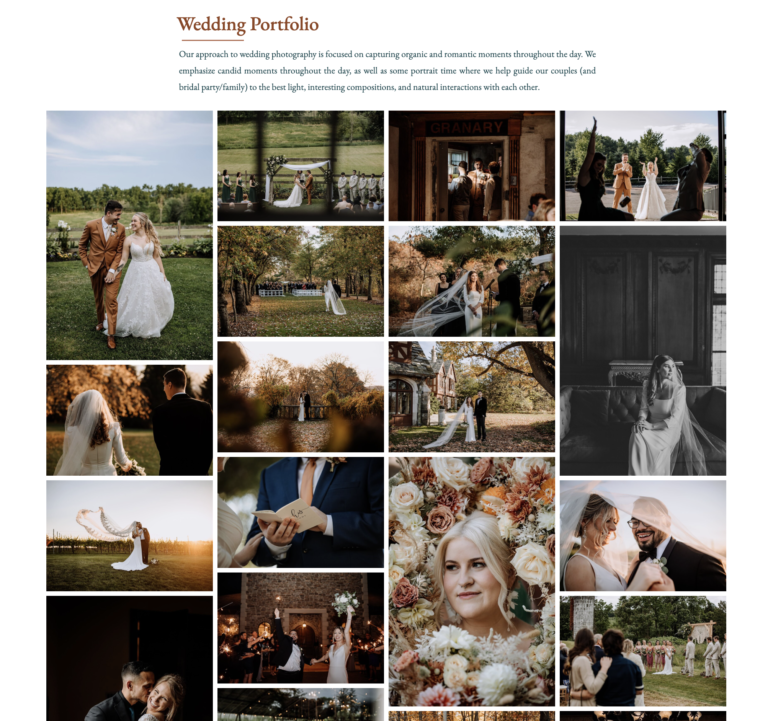
Your portfolio is one of the first things people use to decide whether they should trust you to be their photographer!
I like to think of a portfolio as a sample of the end product.
If you walk into a restaurant and someone gives you a free sample, that sample gives you a sense of what the full meal might be like. Your portfolio works in a similar way. It gives potential clients a taste of what they can expect if they hire you.
It’s important to know, especially if you’re just starting out, your portfolio does not need to be huge at first.
But it does need to show enough consistency that someone can imagine paying you.
If you are trying to get portrait clients, show portraits. If you want wedding clients, you eventually need wedding work in your portfolio. If you want family sessions, show families. If you want branding clients, show branding-style work.
A beginner portfolio can come from:
- Friends and family sessions
- Free portfolio-building shoots
- Low-priced early sessions
- Styled shoots
- Second shooting
- Assisting
- Personal projects
- Model calls
- Local social media posts looking for people to photograph
I do not recommend working for free forever. But in your earliest days, when you do not have enough experience or examples, doing a handful of free or low-cost shoots can be useful.
That is how we got started.
We photographed friends, family, and people we found through simple social media feelers. We needed practice working with real people. We needed to learn how to pose, communicate, manage a shoot, edit consistently, and create images that could live in a portfolio.
Even a handful of shoots can make a real difference!
Once you have a few examples, you have evidence. And evidence matters.
One thing I would be careful about is showing too much too soon. A portfolio should make people feel confident, not confused. If you have 200 images and only 20 of them are truly strong, show the 20. A smaller, more consistent portfolio is usually better than a larger one that feels uneven.
How to Get Your First Photography Clients
Your first photography clients will often come from your existing network or from low-friction local opportunities.
That may not sound glamorous, but it is practical…
When we were first starting, we did not have SEO traffic, vendor referrals, hundreds of reviews, or a polished brand (all things that definitely make getting clients today easier for us!). We had to work with what was available.
Some of our earliest work came through:
- Friends
- Family
- People we knew loosely (acquaintances, coworkers, friends-of-friends)
- Social media posts
- Local online groups
- Free or low-cost portfolio sessions
- A random Craigslist listing here and there like I mentioned in the intro
To give you some more context – one of our earliest weddings was around $500 for full wedding coverage, and I believe we even included a canvas print at the time. Looking back, that is obviously very low. But at the time, it felt meaningful because it gave us a real wedding, real experience, real portfolio images, and a path to the next booking. That mattered a lot for where we were at.
You do not need 50 clients to get started. You need a few.
A couple of early sessions can become portfolio images. A couple of early weddings can become proof that you have photographed weddings. A couple of happy clients can become reviews, referrals, and confidence.
The path from $0 to $500 to $1,000 to $2,000 happened quickly for us once we had a few real jobs under our belt. Not overnight, but faster than it would have if we had stayed stuck waiting to feel perfectly ready.
Keep in mind, I’m not suggesting to just “work for exposure” – but be mindful of the things you’re needing and the value a gig or 2 might provide you outside of just the money. Especially true early on.
If you are trying to get your first photography clients, start with simple steps:
- Tell people you are offering sessions.
- Reach out to friends and family.
- Post a model call on Facebook or Instagram.
- Offer a limited number of portfolio-building sessions.
- Join local community groups where people ask for photographers.
- Price early work in a way that matches your experience.
- Ask for reviews after successful sessions.
- Use the work to build a better portfolio.
The goal is not to stay in this phase forever…
The goal is to get enough experience, examples, and confidence to move forward!
Build an Offer People Can Understand
One mistake I made early in my career was not having enough clarity around what I was actually offering.
This matters more than people realize.
A potential client needs to understand:
- What service you provide
- What outcome they get
- What is included
- What the process looks like
- What it costs
- What they need to do next
If that feels unclear, people hesitate.
Your offer does not need to be perfect at the beginning. In fact, it probably will not be. But it does need to be clear enough that someone can make a decision.
For a portrait photographer, that might mean:
- A 60-minute session
- One location
- A set number of edited images
- Online gallery delivery
- A simple price
- Optional add-ons
For a wedding photographer, that might mean:
- A set number of coverage hours (or just do full day to keep it extremely simple for most people)
- Engagement session included or optional
- Second photographer included or optional
- Online gallery delivery
- Print rights
- Album options
- Payment schedule
- Clear booking process
In my own business now, I use a four-package structure for weddings. Those packages are built around the needs of the clients we want to serve, with full-day coverage playing a central role in many of the offers. That is one of our differentiators.
I did not start there.
Early on, I custom quoted too much and built packages that did not always make sense. Over time, client conversations helped show me what people actually cared about, what confused them, and what made it easier for them to say yes.
Your offer will evolve the same way.
The key is to make it good enough to sell, then improve it based on real conversations and real bookings.
Use Pricing to Match Trust and Experience
Pricing is part of how people understand your offer.
That can be uncomfortable to admit, but it is true.
When you are new and have very little experience, lower pricing can make people feel like the risk is more reasonable. In practice, you’d want to think of this as “introductory pricing” – not your permanent cost. That does not mean you should undercharge forever. It means your early pricing should reflect where you actually are.
Most people are not going to spend high dollar figures on a photographer who does not have much experience, a strong portfolio, reviews, or a clear process.
That is normal.
In the beginning, your pricing may help people take a chance on you. Then, as you gain experience and confidence, you can raise your prices (sometimes rapidly as I experienced!).
I think of this as a pricing progression:
- First, get real experience.
- Then, build evidence.
- Then, improve your portfolio.
- Then, raise your prices.
- Then, refine your offer.
- Then, repeat.
Another fact of the matter is that pricing is somewhat experimental, especially early on.
You might try a price, see if people book it, and then adjust. You might try to be in the ballpark of some other photographers near you for a reference or just trust your “gut feeling.” But ultimately, you set a price and move. Know that you do not need to make a public announcement every time you change your prices, either. You are allowed to evolve, and evolve swiftly if you want.
Ultimately, the pricing mistake is not starting low. The mistake is staying low after your skill, demand, experience, and client experience have grown!
Build a Brand That Gives People a Reason to Choose You
Branding is one of my favorite parts about having a business. Branding gives your business an essence.
Often when people think of a “brand”, they think in fairly shallow or visual terms. Color palette, logo, graphics, etc. These are part of it, but your brand is not just your logo!
Your brand is the overall impression people get when they encounter your business.
It includes things like:
- Your portfolio
- Your website
- Your writing
- Your visuals
- Your editing style
- Your pricing
- Your packages
- Your communication
- Your reviews
- Your personality
- Your client experience
- Your point of view
A strong brand helps people understand why they should choose you instead of another photographer.
This is where your unique selling proposition, or USP, matters.
Your USP is the thing that helps you stand out in a meaningful way.
In my own photography business, a few differentiators include:
- My wife and I photograph together as a team.
- We specialize in weddings, elopements, and portraits.
- We offer a calm, low-key experience.
- We structure many of our wedding packages around full-day coverage.
- We show full galleries so people can see complete work, not just highlights.
- We bring a mix of structure, emotional awareness, and documentary attention to the work.
Some of these things are not completely unique in the entire market, of course. And that is okay. A USP does not always need to mean “no one else in the world does this.” It means your combination of qualities helps the right people understand why you may be the right fit.
If you are newer and trying to figure this out for yourself, you can start with simple questions:
- What kind of client do I want to attract?
- What do they care about?
- What are they nervous about?
- What kind of experience do they want?
- What do I do differently than nearby photographers?
- What kind of work do I want to be known for?
- What can I show or say that builds trust?
It’s easy enough to ask questions like these, but how you come to answers that you like will vary. But some things you can do include…
You can also do competitor research. Look at photographers in your area or niche. What are they emphasizing? What do their websites look like? What packages do they offer? What seems missing? Where might you be able to show up differently?
It is also worth remembering that people are often hiring a person, not just a portfolio. That does not mean you need to become an influencer or turn every platform into a personal diary. But potential clients should be able to get some sense of who they are hiring. A few photos of you, behind-the-scenes moments, short notes about how you work, or client-facing explanations of your process can help people feel more comfortable before they inquire.
In the early days, do not get stuck trying to perfect your brand forever.
Create a basic visual direction. Choose a clean logo. Pick a color palette that fits your style. Build a portfolio that supports the clients you want. Write website copy that sounds like you.
Then improve it over time!
You can always revisit your branding down the line as you start to take on more work!
Give People Enough Reason to Trust You
Ultimately, people need a reason to trust you before they hire you.
That is true for any service, but it is especially true in photography.
A client is not just buying files. This isn’t just some guy who is going to mow their lawn this week. They are trusting you with something personal: a wedding day, a family season, a portrait of themselves, a milestone, a brand image, or a memory they cannot recreate.
When you have 10+ years of experience, hundreds of sessions and weddings, public reviews, full galleries, and a clear process, trust is easier to build. When you are newer, you usually build trust through smaller signals.
Those trust signals might include:
- A focused starter portfolio
- Clear communication
- A simple website
- A professional contract
- Transparent pricing or package information
- A few testimonials
- Behind-the-scenes content
- Full galleries when available
- A clear explanation of your process
- Honest positioning around your experience level
This is another reason not to treat early work casually. Even if you are charging less, you are building proof.
And proof compounds.
One good session gives you images. One happy client gives you a review. One review helps build trust. One trust-building portfolio page helps generate the next inquiry.
That is how the early stages start to stack…
Of course, you need to also find ways to show people this evidence…which leads us to our next section!
Understand the Marketing Funnel
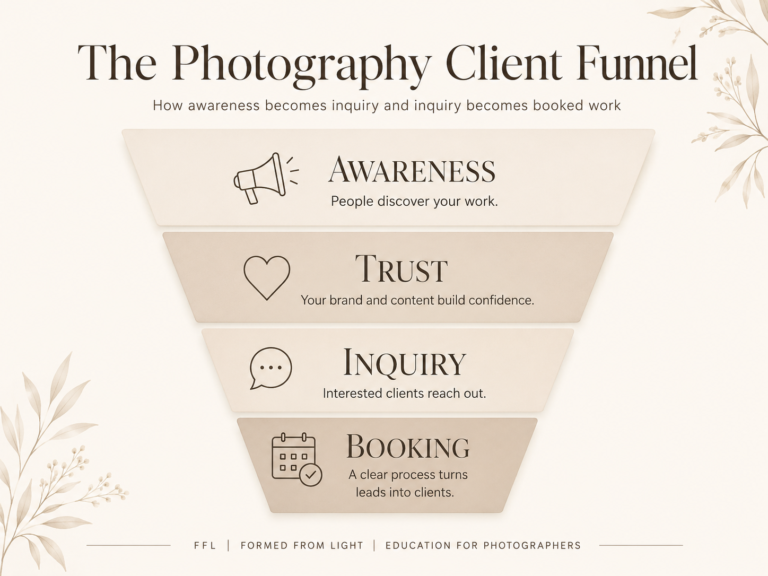
A simple marketing funnel can help you understand how photographers get clients.
At its simplest, the funnel has three parts:
- Top of funnel (ToFu): people become aware of you.
- Middle of funnel (MoFu): people learn more and start to trust you.
- Bottom of funnel (BoFu): people inquire, talk with you, and book.
This matters because photographers often focus only on top-of-funnel marketing.
Think about it – They post on Instagram. They make a TikTok. They publish a blog post. They reach out to a vendor.
That is all good. But awareness is only the beginning.
Once someone becomes aware of you, they need a place to go. Usually, that place is your website.
Your website then helps them move through the middle of the funnel by showing your work, explaining your approach, sharing pricing or package information, showing reviews, answering questions, and making the experience feel trustworthy.
Then, if they are interested enough, they reach out.
That is the bottom of the funnel.
At that point, your inquiry response, follow-up, consult call, pricing guide, proposal, contract, and invoice all matter.
It’s important to note that if one part of the funnel is weak, clients may drop off. For example:
- If no one knows you exist, you have a visibility problem.
- If people visit your website but never inquire, you may have a trust or clarity problem.
- If people inquire but never book, you may have a sales process or offer problem.
- If people love your work but cannot afford you, you may have a positioning or audience problem.
Getting clients becomes easier when you stop seeing marketing as one isolated task and start seeing it as a path people move through.

Get a Free Automated Inquiry Response Email Template
Use Multiple Marketing Channels, But Build Them in Layers
There are many ways photographers get clients. Or rather – attract clients.
The mistake is trying to master all of them at once.
A mature photography business often has several lead sources working together. In my own business today, leads come from SEO and blogging, social media, vendor referrals, venue relationships, past clients, word of mouth, and other photographers who refer us when they are unavailable.
That did not happen immediately…
The first two to three years were really the building phase. We were figuring things out, creating work, building relationships, improving the website, posting, blogging, experimenting, and gradually creating enough momentum that the business became more stable.
The best approach is to build marketing channels in layers.
Start with what is most accessible. Pick one or two marketing channels you can actually focus on and do consistently. Then, as those channels become more stable and start producing traffic, inquiries, or relationships, add another layer.
That is usually better than trying to do Instagram, TikTok, Pinterest, blogging, networking, paid ads, email marketing, vendor outreach, and YouTube all at the same time. When you try to do everything at once, it is easy to do all of it lightly and none of it well.
One thing I would also try to avoid is only marketing when you are already slow.
That creates a cycle where you get busy, stop marketing, finish the work, and then wonder where the next inquiries are coming from. The goal is not to market at full intensity every day forever, but you do want some consistent activity that keeps the business visible even when you are busy serving current clients.
Friends, Family, and Personal Network
This is often the first marketing channel for photographers.
People who already know you may be more willing to let you practice, hire you early, or recommend you to someone else.
This can include friends, family, coworkers, acquaintances, local community connections, or people from school, church, hobbies, or previous jobs.
This is not always a long-term strategy by itself, but it can help you get early traction.
Some of my earliest work were friends and family, both for portraits as well as having photographed a cousin’s wedding in the mix.
Social Media
Social media can be useful because photography is visual, and well, it lets people connect with other people pretty easily (the “social” aspect of it).
Instagram has been valuable in my own business over the years especially, since it’s one of the social platforms I decided to focus in on. It has helped us show our work, stay visible, connect with people, and book clients.
Today, photographers may use Instagram, TikTok, Facebook, Pinterest, YouTube Shorts, or other platforms depending on their niche and audience.
The key is not just posting randomly. Social media works better when your content helps people understand what you photograph, who you serve, what your style feels like, what the experience is like, what kind of person you are, and how to take the next step.
A good social presence should eventually guide people somewhere deeper, usually your website or inquiry form.
SEO and Blogging
Search engine optimization (SEO) and blogging have become one of the strongest lead sources in my business.
This took time to build. It was not instant. But after creating a lot of content around weddings, venues, locations, sessions, and questions our clients were searching for, people started finding us naturally through Google.
That kind of organic traffic can be very valuable because people are often searching with intent.
For example, someone searching for a wedding photographer at a specific venue is much closer to hiring than someone casually scrolling Instagram.
Useful SEO content for photographers can include:
- Venue guides
- Location guides
- Session examples
- Wedding galleries
- Planning tips
- Pricing guides
- Local photography pages
- “Best places for photos” posts
- Frequently asked client questions
SEO is one of the marketing efforts I think is most valuable, but it is also slow moving early on. Investing time and energy into SEO content can pay off months and years down the line, but that does not mean the content is useless while you are waiting for it to rank.
The key is learning how to use SEO content in a way that supports bookings today!
For example, a blog post from a recent wedding or portrait session may eventually bring in search traffic. But even before that happens, you can send it to a potential client who wants to see more examples of your work. You can link it from your pricing guide. You can share it with a vendor. You can use it to show how you approach a venue, a lighting situation, a session type, or a client experience.
That is stronger marketing than only posting the images once on social media and hoping the algorithm shows them to the right people.
SEO can take months or years to build into a serious lead source. But once it starts working, it can become one of the most stable parts of your marketing.
Google Business Profile and Directories
Having a Google Business Profile can be valuable for local photographers, especially if you serve a specific city or region.
It is one of the simpler local visibility tools to set up, and it can help people find you when they are searching for photographers near them. This is especially useful for photographers with a clear service area, like family photographers, portrait photographers, headshot photographers, and wedding photographers who serve a specific region.
A basic Google Business Profile checklist would include:
- Claim or create your profile.
- Set your service area if you work from home or do not want to show a studio address.
- Add specific services, not just “photographer.”
- Upload strong images that represent the work you want to book.
- Keep your business name, website, phone number, and contact information consistent.
- Ask happy clients for Google reviews.
- Keep the profile reasonably current with updated images or posts when appropriate.
For wedding photographers, platforms like The Knot, WeddingWire, venue directories, and local vendor lists may also play a role.
Some directories are more useful than others. Some may bring leads. Some may bring price shoppers. Some may not be worth the cost. This depends heavily on your market and niche.
The main thing is to track results. Do not pay for a directory forever just because it feels like something you are supposed to do.
Vendor and Venue Relationships
Relationships can be extremely valuable. This is especially true in the wedding industry, but even portrait photographers have others that can be partnered with!
Venues, planners, florists, DJs, videographers, hair and makeup artists, and other photographers can all become referral sources over time.
These relationships usually take time to build. You build them by doing good work, being easy to work with, sharing images, tagging vendors, sending galleries, communicating professionally, and staying visible.
Today, we have multiple venues that recommend us for wedding photography services. That did not happen because we sent one email and got on a list (well, most of the time, lol). It happened through repeated work, trust, and relationships being built over time.
Reviews, Referrals, and Repeat Clients
Getting a new client is valuable, but the clients you already have can become one of the strongest parts of your business over time.
In fact, stats show that businesses have a 60-70% chance to sell another product or service to a past customer (huge!) while selling to someone new is more around 5-20%.
This is easy to overlook early on because most photographers are focused on finding new people. More visibility. More inquiries. More traffic. More followers. Those things do matter, but they are not the whole picture.
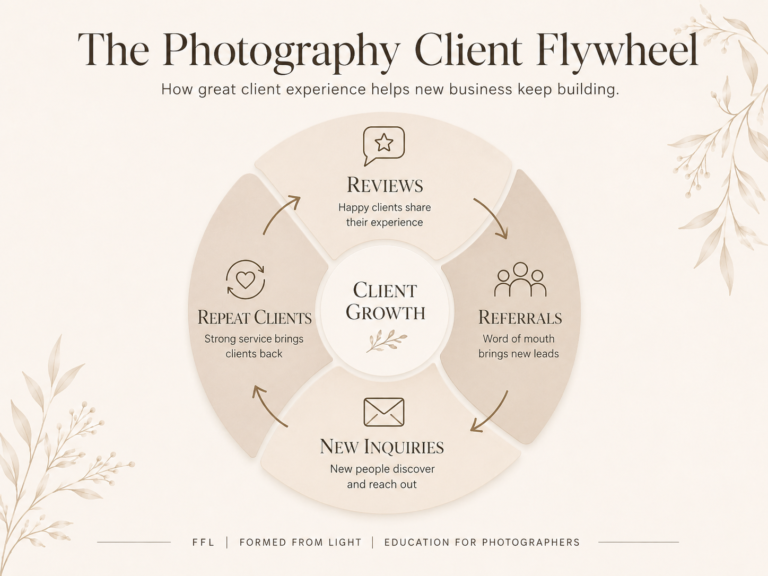
Word of mouth can become one of the strongest lead sources once you have happy clients. Past clients can refer friends, family, coworkers, and relatives. They can also return for future sessions, albums, prints, anniversaries, maternity, newborn, family, or branding work.
This is where client experience really comes into play.
People refer photographers they trust, not just photographers who take nice photos.
A happy client can give you three things that are hard to manufacture from scratch:
- a review
- a referral
- and a reason to work together again.
Reviews help future clients trust you before they ever talk to you. Referrals are usually warmer than cold leads because the trust is partially transferred from the person making the recommendation. Repeat clients often require less convincing because they already know what it feels like to work with you.
A simple post-delivery process can help with this. After you deliver a gallery and know the client is happy, ask for a review. Make it easy. Send the link. Give them a small prompt if they are not sure what to say. You do not need to make it awkward or overly scripted. Most people are willing to help if they had a good experience, but they may not think to do it unless you ask.
You can also make referrals easier by giving clients simple language. Something as basic as, “If you know anyone looking for a photographer, I’d always be grateful if you passed my name along,” can plant the seed without feeling pushy.
With that said, repeat clients depend on staying visible after the gallery is delivered. This is where email marketing, seasonal session announcements, anniversary check-ins, mini-sessions, album reminders, and past-client updates can help. The point is not to bother people. The point is to avoid disappearing forever after the initial work together ends.
In our experience, the best long-term businesses are not constantly starting from zero. They create an experience people remember, then they stay connected in simple, thoughtful ways.
Want help creating a stronger client experience for your photography clients?

Learn More about the Client Experience Nurturing System
Email Marketing
Email marketing for photographers is useful because it gives you a way to stay connected with current and past clients outside of social media. It really operates in that “middle of funnel” part of your marketing plan.
In my business, email can support future portrait sessions, mini-session announcements, print and album sales, seasonal updates, past-client offers, and helpful planning content.
Clients who already had a positive experience with you are often more likely to buy from you again or recommend you to someone else.
Email marketing is not usually the first thing a brand-new photographer needs to master, but it is worth thinking about earlier than most people do.
If you need a simple email marketing tool to use, I recommend giving Flodesk a try.
Cold Outreach
Cold outreach (which is when you just reach out to someone who doesn’t know about you), can work, especially for commercial, branding, headshot, product, real estate, or local business photography.
For those kinds of businesses, direct outreach can be a legitimate client acquisition strategy because there are often specific businesses, brands, agencies, or professionals who may need photography but are not actively searching for you yet.
A product photographer might pitch skincare brands, restaurants, boutiques, or makers. A headshot photographer might reach out to local companies, real estate offices, medical practices, or law firms. A branding photographer might connect with designers, coaches, consultants, or small business owners.
For wedding photography, cold outreach usually looks different. I would generally not recommend randomly pitching couples who have not expressed interest. Instead, wedding photographers are usually better served by building relationships with venues, planners, florists, videographers, DJs, and other vendors who are already part of the wedding ecosystem.
With that said, the key is relevance.
Good outreach should feel specific, clear, and respectful. You should know why you are reaching out, what you can offer, and why it might matter to them. A generic email sent to 200 people with no context is not the same thing as thoughtful outreach.
For example, even a wedding photographer could do some cold outreach like if they were to touch base with every new Instagram follower that came through their account (and this is a legit marketing strategy when done right!).
A simple portfolio link, a clear offer, and a reason for the message can go a long way.
Paid Advertising
Paid advertising (like ads on Instagram, Facebook or Google) can work, but I would be cautious about making it your first client acquisition strategy.
In practice, ads should amplify what is already there.
If your offer is unclear, your website is confusing, your portfolio is thin, or your inquiry process is weak, paid ads may simply send more people into a system that is not ready to convert.
This is why I’d typically suggest making sure you’re able to secure at least a few bookings of your own through organic marketing efforts (ie: non-paid) to make sure their is demand and things already set up are working.
With that said, that does not mean photographers should never use ads. They can be useful for mini-sessions, portrait promotions, local visibility, retargeting, or driving traffic to a already strong and validated offer.
In particular, retargeting ads are probably some of the best ones out there. But before spending money, I would make sure you have a clear service, a page that converts, a way to track leads, and a booking process that actually works.
Otherwise, you may end up paying to discover problems you could have fixed first.
Make It Easy for People to Inquire
Once your marketing engine starts working, you need a simple way for people to contact you.
This sounds pretty basic, but it is where a lot of photographers lose potential clients.
Your website should make it clear:
- what you photograph
- where you are located
- who you serve
- what the next step is
- how to inquire
At minimum, I would recommend having:
- a clear contact page
- a simple inquiry form
- a professional email address
- an easy-to-find call to action
- a process for tracking leads
But photography website conversion is about more than just having a contact form. Your website needs to help someone feel comfortable enough to use it.
A stronger photography website usually includes:
- Clear service and location information
- A focused portfolio
- Full galleries or deeper examples of your work
- Reviews or testimonials
- Package or pricing direction, even if you do not list every price publicly
- A helpful about page
- FAQs that answer common buying questions
- A simple contact form
- Clear CTAs on important pages
- Blog posts or resources that support trust
You can manage some of this manually at first. A form submission can come into your inbox, and you can track leads in a spreadsheet if you need to. But as your business grows, a CRM can make the process much easier.
I use HoneyBook in my own business. It allows me to collect inquiries, manage projects, send emails, build brochures, send proposals, collect signatures, send invoices, and keep the booking process organized.
That matters because getting a client is not just about attracting the lead. It is about not losing them once they reach out, too!
Respond Quickly and Guide the Lead Toward Booking
Here’s a reality check – when someone inquires, they are not officially your client yet.
For a long time I would get so excited when I got a new inquiry (especially one that someone filled out my form and sounded super excited to work with me), but then it ends up going no where…we’ve all been there…
Instead, when someone reaches out, I now look at it like this…They have expressed interest. That is all.
Now you need to guide them.
This is where your sales process matters.
At minimum, your sales process should include:
- a quick initial response (I suggest using an autoresponder email as part of this)
- a clear answer to their questions
- pricing or next-step information
- a way to schedule a call if needed
- follow-up if they do not reply
- a contract
- an invoice or retainer payment
- a clear booking confirmation
In my early days, this process was clunky.
People would contact us by email. We would often meet in person. Contracts were printed on paper. Sometimes they had to be mailed. Payments might come by check. It worked, but it was slow and inconvenient.
I can imagine we lost opportunities because the process was not modern or easy.
Today, when someone tells me they want to move forward, I try to send the proposal as quickly as possible. In HoneyBook, my proposal includes the contract and invoice schedule, so they can review, sign, and pay online.
That makes booking easier.
One important sales lesson is this: when someone decides they want to work with you, make it as easy as possible for them to make that official.
Do not create unnecessary friction.
If someone has to wait days for a contract, print paperwork, mail a check, or chase you for next steps, the momentum can fade.
Use Follow Ups Without Feeling Pushy
A lot of photographers stop after one response…Can you believe it?!
They receive an inquiry, send an email, and then if the person does not respond, they assume the lead is dead.
Sometimes that is true. But most of the time it’s not. Statistically, businesses that perform best follow up (often multiple times).
But often, people are busy. Your email may have gone to spam. They may be comparing options. They may be overwhelmed. They may have intended to reply and simply forgot.
Following up is not automatically pushy or “salesy.” Actually, it can be helpful!
A simple follow-up process might include:
- initial response as quickly as possible
- first follow-up 2 to 3 days later
- second follow-up 5 to 7 days later
- final soft close if appropriate
I personally use a follow up sequence that ends up running for around a month after someone reaches out to me (and have booked clients on the last email in that sequence, too!).
Keep in mind, an important aspect of these follow up messages is that what they contain matters.
It’s the tone and content of the messages that matters.
You are not begging. You are not pressuring. You are making it easy for someone who already expressed interest to continue the conversation.
It’s also important to make sure you’re adding value (like sharing resources) to make these more than simple “hey – you wanna book me?” types of emails.
This is especially important for higher-value photography services like weddings and elopements, where clients often need multiple touchpoints before making a decision.
Need help knowing what to say, how to say it, and when? We built the Inquiry to Booking System to help photographers do just this. It includes email and text message templates, as well as detailed walkthroughs and advice for how to structure your communication with leads until they become a booked client.

Learn More about the Inquiry to Booking System
Track Which Client Sources Are Actually Working
Once you have more than one way people are finding you, it is worth tracking where your photography leads are actually coming from.
This does not need to be complicated. You do not need some massive spreadsheet with 40 tabs. But you should have a basic way of seeing which client sources are creating inquiries, which ones are creating bookings, and which ones are mostly creating noise.
Useful things to track include:
- Source of inquiry
- Number of leads per month
- Number of bookings
- Booking rate by source
- Average booking value
- Lead quality
- Notes on why they booked
- Whether they were referred by a past client, vendor, venue, Google, social media, or another source
This matters because not all leads are equal.
You might get 20 inquiries from one directory and only book one. You might get five inquiries from past clients and book four. You might get fewer leads from SEO than Instagram at first, but those SEO leads may be more ready to hire because they were searching for something specific.
Without tracking, it is easy to make decisions based on feelings.
You may think Instagram is working because people like your posts, but your actual bookings are coming from Google. You may think a paid directory is worth it because it sends inquiries, but if none of those inquiries book, the return may not be there. You may think vendor relationships are not doing much, but one planner referral could become a high-value wedding.
Tracking gives you a clearer picture.
And once you know what is working, you can put more energy there.
What If You Are Getting Inquiries But Not Bookings?
Now, here’s a tough spot to be in, but don’t lose hope! If you are getting inquiries but not booking clients, that tells you something really important.
Your marketing is working at least enough to create interest (generating awareness at the top of the marketing funnel like we covered earlier).
The issue may be later in the process.
Common reasons photographers get inquiries but not bookings include:
- pricing is not aligned with the audience
- the offer is unclear
- the response is too slow
- the email does not guide the next step
- there is no follow-up
- the website builds interest but not enough trust
- the portfolio is attractive but not specific enough
- the booking process has too much friction
- the consult call is not helping the client feel confident
This is where you need to look at the full client path.
Where are people dropping off?
- If people visit your website but never inquire – improve the website, portfolio, messaging, CTA, and trust signals.
- If people inquire but never reply – improve your inquiry response and follow-up.
- If people get on calls but do not book – improve your offer, pricing, consult process, or proposal.
- If people say you are too expensive – you may need to either build more trust, adjust your audience, change your offer, or revisit your pricing.
Do not assume the answer is always “I need more leads.”
Sometimes the better answer is: “I need to convert the leads I already have.”
How to Get Photography Clients as a Beginner
If you are a beginner, the path is simpler than it may feel.
You do not need to build every marketing channel immediately.
Focus on these priorities when you’re starting out:
- Build a small portfolio.
- Create one clear offer.
- Tell people you are available.
- Make it easy to contact you.
- Price in a way that matches your experience.
- Do good work.
- Ask for reviews.
- Use each job to create better proof.
- Start working on 1-2 other forms of marketing (blogs, IG posts, etc.) alongside
Think about it like this: in the beginning of your photography career, you are building evidence.
Evidence that you can photograph people well.
Evidence that you can communicate clearly.
Evidence that you can deliver what you promised.
Evidence that someone else trusted you and had a good experience.
That evidence helps the next person trust you…
You may feel like you need a perfect brand, website, CRM, email list, social strategy, and SEO plan before you can start. But you don’t…
Those things help, and you should definitely build them over time…
But the first step is often much more direct: create work, show it to people, invite people to hire you, and make the experience good enough that it can lead to the next opportunity.
What I’d Focus on First If I Were Starting Today
If I were starting a photo business from scratch today, I would not try to build every marketing channel at once. I would instead focus on the pieces that create proof and make booking possible early on without as much friction.
1. Choose One Primary Type of Photography
Not because you can never change, but because it is easier to build momentum when your portfolio, offer, website, and marketing all point in one direction.
2. Create a Small but Focused Portfolio
I would rather have 20 strong images that clearly show what I want to book than 100 mixed images that make the business feel unclear.
3. Build One Simple Offer
It does not need to be perfect. It just needs to be understandable. People should know what they get, what it costs, and what happens next.
4. Make a Basic Website With a Clear Contact Form
Not a perfect website. A functional one. The goal is to give people a place to see the work, understand the offer, and reach out.
5. Start With Accessible Marketing
Friends, family, local groups, social media, and portfolio-building opportunities can help create early momentum. Then, as soon as possible, I would start creating SEO content and relationship-based marketing that can compound over time.
6. Build a Simple Inquiry Response and Follow-Up Process
Even if you only get a few leads at first, treat them seriously. The way you handle early inquiries can teach you a lot about what people need before they feel ready to book.
If you need help in this area, our free automated inquiry response email template is a great help, and you can explore our full Inquiry to Booking System in the Shop if you want even more help!
6 Common Mistakes Photographers Make When Trying to Get Clients
There are a few mistakes I see photographers make when they are trying to get more clients.
Waiting Too Long to Start
Some photographers wait until everything feels perfect.
The portfolio. The logo. The website. The pricing. The captions. The gear.
At some point, you need real feedback from real people.
You can improve as you go!
Marketing Without a Clear Offer
Posting pretty photos is not the same as selling a service.
People need to understand what you offer, who it is for, what they get, and how to take the next step.
Depending Only on Social Media
Social media can work, but it should not be your whole business.
Platforms change. Reach changes. Algorithms change. Your account can slow down or disappear. Build assets you have more control over, like your website, SEO content, email list, reviews, and referral relationships.
Marketing Only When You Are Slow
A lot of photographers fall into a feast-or-famine pattern.
They market when they are slow, get a few bookings, become busy, stop marketing, finish the work, and then realize the next wave of inquiries is not there.
This is why consistent marketing matters. It does not mean you need to be everywhere every day. It means you should have some repeatable marketing activity that continues even when client work picks up.
Not Following Up
One of the worst offenders because if you’re getting leads and losing them (and not doing anything about it), your not taking advantage of the opportunities already in front of you. Unfortunately, a lot of bookings are lost because photographers simply do not follow up.
Making Booking Too Hard
If someone wants to hire you, make the process as easy as possible.
Send the proposal quickly. Use a clear contract. Make payments simple. Confirm the next steps.
FAQ: Getting Photography Clients
How do photographers get clients when they are just starting out?
Most photographers get their first clients through friends, family, social media, local groups, free or low-cost portfolio shoots, and word of mouth. The goal is to build enough experience, portfolio work, and reviews to make future clients feel more comfortable hiring you.
How do I get photography clients with no experience?
Start with practice sessions, friends and family, model calls, assisting, second shooting, or low-pressure portfolio-building shoots. Avoid taking on high-stakes paid work before you are ready, especially weddings.
How do photographers get clients online?
Photographers get clients online through social media, SEO, blogging, Google Business Profile, directory listings, email marketing, and a website that clearly shows their work and makes it easy to inquire.
What is the best way to get more photography clients?
The best way depends on your niche and stage of business. For beginners, personal networks and portfolio-building can work well. For established photographers, SEO, referrals, vendor relationships, email marketing, and a strong inquiry process can create more consistent leads.
How do you get wedding photography clients?
Wedding photographers often get clients through portfolio-building weddings, second shooting experience, SEO content around venues and locations, referrals from past couples, vendor relationships, social media, wedding directories, and a clear inquiry-to-booking process. For wedding photography, trust is especially important because clients are hiring you for a once-in-a-lifetime event.
How do you get portrait photography clients?
Portrait photographers often get clients through personal networks, social media, local SEO, repeat clients, seasonal sessions, referrals, email marketing, and portfolio content that clearly shows the kind of people and sessions they want to photograph. Portrait work can also grow through past-client relationships because people may return for updated photos over time.
How do photographers get repeat clients?
Photographers get repeat clients by delivering a strong experience, staying in touch after gallery delivery, using email marketing, inviting clients back for seasonal sessions, and making future bookings easy. Repeat clients usually come from trust, not constant selling.
How many clients do you need to start a photography business?
You only need a handful of early clients to begin building proof. A few good sessions or weddings can help you create portfolio images, reviews, and confidence that lead to more bookings.
Why am I getting photography inquiries but not bookings?
You may have an issue with pricing, offer clarity, response speed, follow-up, trust signals, consult calls, or booking process. If people are inquiring but not booking, look at what happens after they contact you.
Final Thoughts
So, how do photographers get clients?
They build trust, show good work, create clear offers, market consistently, and make it easy for interested people to book.
At the beginning, that may look like photographing friends, family, and low-cost early clients so you can build a portfolio. Later, it may look like SEO, blogging, social media, vendor relationships, past-client referrals, email marketing, and a well-built inquiry-to-booking system.
The specific marketing channels can change.
The underlying process stays the same (when it’s built well that is).
People need to know you exist. They need to like and trust your work. They need to understand what you offer. They need a reason to reach out. And once they do, they need to be guided clearly toward booking.
If you are just starting, focus on getting a few real shoots under your belt.
If you already have inquiries coming in, focus on improving your response, follow-up, and booking process.
Getting clients is not magic. It is a set of repeatable actions that become stronger over time.
Where to Go Next
If you are still building the foundation of your business, start with the broader guide on starting a photography business.
If you want to explore the broader structure behind this topic, visit the Photography Business hub.
If you are getting inquiries but not enough bookings, the Inquiry to Booking System for Photographers is built to help you respond clearly, follow up intentionally, and guide leads toward booking.